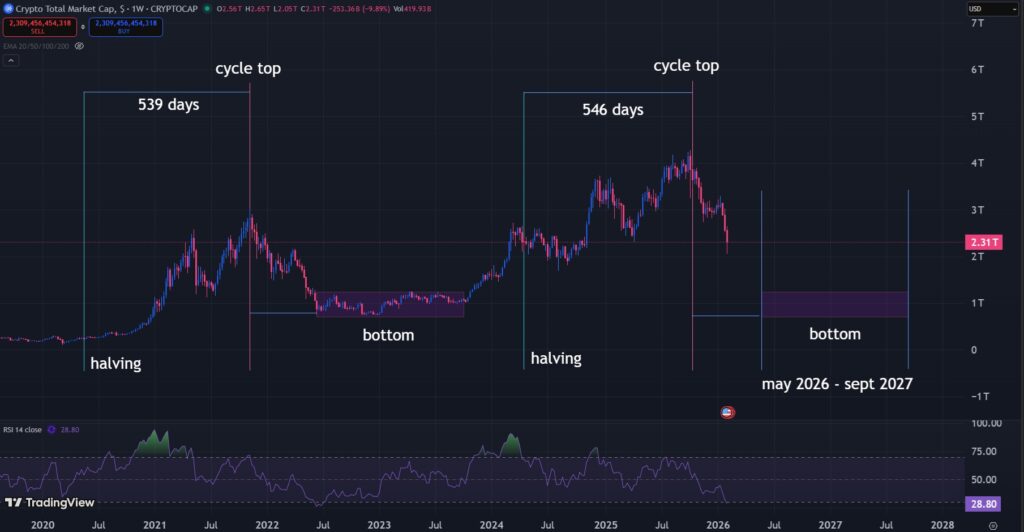
I mapped out the Crypto Total Market Cap and marked the key phases of the last two cycles: halving → cycle top → bear market → bottom.
When you zoom out and remove the noise, structure becomes clearer.
Time From Halving to the Top
What stands out:
- Last cycle: ~539 days from halving to the top
- Most recent cycle: ~546 days to the top
That’s a very small difference.
Time-wise, the cycles are remarkably consistent.
This is why understanding crypto cycle structure matters more than predicting short-term price moves. Markets rarely repeat perfectly — but they often rhyme in rhythm and psychology.
Where Real Bottoms Actually Form
The more important part:
Real bottoms don’t form right after the top.
They come later — after a long, boring period where interest fades, conviction disappears, and most people simply stop paying attention.
This phase is psychologically brutal. Volatility compresses. Liquidity dries up. Media coverage disappears. Retail participation collapses.
If you study previous cycles, including the behavioral patterns discussed in reading the current market cycle, you’ll notice that the final bottom usually forms when emotional exhaustion replaces fear.
The Potential Bottoming Window
On the chart, I’ve highlighted a potential bottoming window for the next cycle — roughly May 2026 to September 2027.
This is not a price prediction.
It’s a time-based framework, built on how previous cycles unfolded.
Markets operate in liquidity waves. Expansion phases create euphoria. Contraction phases create despair. If you don’t understand how liquidity enters and leaves the system, read how M2 money supply is created. Macro liquidity sets the background for every risk asset, including crypto.
What Actually Gets Rewarded
Markets don’t reward those who chase every move.
They reward those who:
- Understand cycles
- Know how to wait
- Survive the bear market without major mistakes
Most money isn’t made at the top.
It’s made quietly — between the bottom and the next expansion phase.
This is where discipline matters. This is where capital preservation matters.
If you lose 70% in the bear market, you don’t have dry powder for the next cycle. Risk management isn’t optional. It’s structural.
Final Thoughts
Cycles won’t repeat perfectly.
But human behavior does.
Greed at the top.
Capitulation near the bottom.
Disbelief during early recovery.
If you can recognize the rhythm without getting emotionally pulled into every move, you already have an edge.
Risk is real. Bear markets are real.
But so are cycles.
Stay patient. Stay solvent. Stay rational.